 S & T Notes - issue 137
 S & T Notes - issue 137
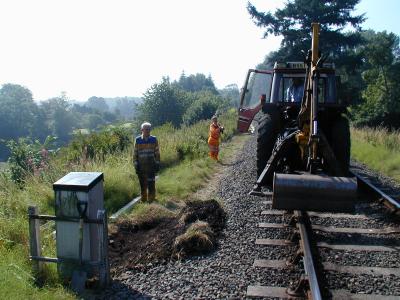
A pleasant day for some gardening in the countryside with a big spade. It is 10.5 a.m. on the Thursday of S&T week
and we have nearly an hour for the first digging session before the first train needs to depart.
SIGNALLING NOTES - Chris. Hall
I think the magazine is becoming more punctual- here I am again
with just a few scratch notes and the Summer edition has dropped
through the letter box - time to put pen to paper again! The last
article was written in a bit of a hurry
just in time to describe some faults that had developed. The faults were
investigated and repaired shortly after the press deadline for the last article
so I'll bring these items up to date before going on to describe
our more recent activities, covering the period from early May to the end of
July.
The fault on Bewdley South Down Main Distant had disappeared
when we opened up the signal machine on 13 April but it failed again
a few days later
and was repaired on 6 May by Tony Neath and Adrian Hassell, the
fault being traced to tensioning of the signal machine carbon
brushes.
The developing cable fault in Alveley Woods became a complete
failure in early May when the cable finally parted under the strain.
A new 150yard length of cable was brought to site by train and
on 7 May a repair gang consisting of Steve Bradbury, Paul Marshall,
Bob Lawson, Adrian Hassell, Grahame Gardner and Ian Southwell cut and
jointed the cable, removing the many temporary links which had
been provided to work around the initial cable fault. A comprehensive
testing programme, which involved the removal of more than one token at once,
was carried out to prove the integrity of the repair and the token
working was booked back on by the end of the day.
The failure of the drive to the yard points at Arley proved to be at the
crank under the lever frame. The crank had cracked - but the crack was hidden -
and the points had become occasionally difficult to operate. Finally the
crank had parted. A replacement crank was fitted by John Smith and Tony Neath
on 5 May and the points readjusted and booked back on.
The workload on the S&T department always seems to peak at times when a large
proportion of the department are away on a canal boat. We don't all tend
to go away at the same time these days so were able to resource the
work despite some members being 'on a cruise'.
Routine and defect maintenance
Signing on at Kidderminster on 2 June for some S&T work, Dave Carr and
myself found our attention drawn to a note about difficulty with number
60 electric lock. The previous day's signalman had very helpfully
diagnosed that the problem was connected with failure of the electric
lock on lever 25 to engage properly. Armed with this information we descended
to the nether regions of the box and found 25 electric lock to be covered
in oil and unable to engage the lock slide with the lever fully reverse.
This is the usual two separate faults which cause a problem. Removing
the oil required us to remove the lock slide, its connection to the
tappett and the electric lock mechanism, strip everything down to its
component parts and remove every trace of oil.
Reassembling showed that the lock slide was over-travelling by about 1/32". The
cut out which engages the electric lock was widened and the equipment
reassembled. Testing showed that all was well and we adjourned to Bewdley.
Routine track circuit testing at North box nicely filled the remainder
of the day.
On 27 June a problem was reported at Hampton Loade which prevented the Down Starting signals
from being cleared. The investigation showed that there was a screw loose
in the wooden case relay which maintains the section signal release - combined with
the contact box on lever 13 being out of adjustment.
Other work has included renewal of the lamp cable on the Down Back Road Inner Home
Signal at Bewdley North which had failed with a short circuit, machining of
the reflective surrounds to be fitted to the road signals at Northwood crossing,
renewal of frayed and rusty signal wires on the From Kidderminster to Down Main Inner Home Signal (no. 6)
and the From Hartlebury to Down Sidings Inner Home Signal (no. 20).
On 5 July at around 0930/1000 'a subcontractor from Barnsley' drilled
through a signalling cable on Oldbury viaduct. The initial report that 'nothing would work'
was discussed with the CS&TE, who was on his way home to Cardiff, and was
refined to track circuit 1AT shewing occupied when clear (28T was still operating
correctly from its track feed battery, despite the power being dead), indication
of the Down Main Home shewing 'wrong' and loss of bell communication with Highley.
The light engine had been signalled normally but the loss of communication meant
that 'train entering section' could not be sent. With no bell communication between
Highley and Bridgnorth trains would not be able to cross at Hampton Loade and
pilotman working on the long section token would have to be implemented.
At this stage it looked as if war weekend might have to be operated with a reduced
service of trains. The earliest that the Department could respond was the Thursday
evening when the location of the cable fault was traced to Oldbury viaduct (it could have
been anywhere between Highley and Bridgnorth) but no evidence was found of the ground
having been disturbed. The CS&TE returned on the Friday, having arranged for
Kidderminster C&W to load some telecomms. cable on the first down train with a
stop order to deliver it to site. This temporary cable was fortunately long enough to reach
from the location cupboard at the Down Home Signal to some soft ground beyond the viaduct
where the existing cable could be cut and jointed. The site of the failure was
fairly obviously at the point where a hole had been drilled right through the viaduct.
The hole was about 6ft6in below the top of the parapet, i.e. about 2 feet below the surface.
The cable had lain at this level (rather deeper than normal) because the viaduct had been
dug out at the time that the pole route was converted to cable run.
The temporary cable allowed essential signalling circuits to be reinstated by late
afternoon on the Friday, so that the 4.0 pm Bridgnorth departure could cross at
Hampton Loade. Two faults remained - the Down Home Signal berth track
showed occupied and the indication of the Down Main Home showed wrong. The signalman
was advised that the Down Main Home should not be used without a man on the ground
to confirm that it had returned to Danger and that the signal post telephone was in order.
A team of three (Tony Neath, John Smith and Dave Beaman) concluded the temporary repair
on the Sunday (8 July) replacing a fuse in the location to restore the feed to 1ATPR and
connecting the two remaining cores for the arm repeater and the metallic earth.
A permanent repair was planned for S&T week.
Routine maintenance is now planned in accordance with a schedule and this has made much
better use of our limited resources and avoids duplication. Although the inevitable
equipment or component failures will still occur, the reliability of the signalling
equipment has much improved over the last four years. I should emphasise that we have
about 200 working levers and that on a typical working day there must be hundreds (if
not thousands) of lever movements and relay and electric lock operations which take
place every day without any problems at all. It was interesting to read in the
volunteer newsletter that a 'review of the S&T maintenance had taken place' as it appeared
that no-one in the Department had written it. The CS&TE promised to share the report
with members of the Department.
S&T week
During our annual S&T week we got off to a gentle start with our annual Sunday Luncheon
on the Venturer. We made appropriate gestures at the Kidderminster signalmen
(Station and Junction) as we passed, who had expressed a preference to work their signalbox instead of joining
us for the meal, and then settled down to a lengthy drinking session. On the Monday
Denvir Drury top nutted the cable terminations on Oldbury viaduct ready for the permanent repair
and investigated the power supply to our Bridgnorth S&T stores, which we found is now supplied
from the Pattern Shop and is therefore turned off when the shop is closed (but, it now seems,
is still off when it is open).
On the Tuesday we were joined by Steve Curtis, John Phillips and myself and we
completed the troughing run to the Boiler Shop Ground Frame location cupboard
and carried out routine FPL and detection testing at Bridgnorth, revealing the need to
shim the yard points at the next opportunity (this was done on 12 August and required
a visit to the workshops to shorten a P-Way stretcher that was preventing the points
from closing up once we had added the correct shims). Meanwhile Kidderminster C&W had loaded
the cable drums we had identified onto the driving school coach which had been taken to Kidderminster by
the Bewdley light engine. The coach was delivered to Bridgnorth by the engine off
BS1 and taken onto shed to allow the BN1 engine to draw the well wagon (onto which
a pallet of troughing had been delivered) out of the boiler shop and propel
it to site for the troughing to be unloaded. Replacing the wagon, the engine then
moved the coach to the Hollybush Road siding for us to load the following day.
On the Wednesday we were joined by Dave Wittamore and we loaded the cable drums
used for the Boiler Shop ground frame location work for recovery to Kidderminster,
with thanks to the Bridgnorth JCB for its assistance. We then assembled for a journey
to Stafford to visit the no.4 and no.5 signalboxes as part of a trip organised by Dave
Wittamore through the IRSE. Our thanks are due to Railtrack, especially the Signalling
Manager, the signalmen and GTRM who conducted us round the locking and relay rooms.
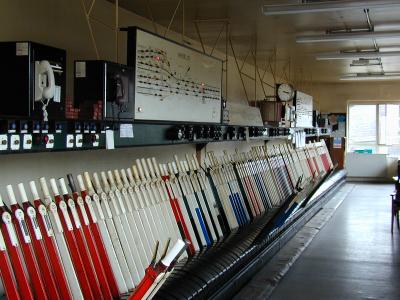
Stafford no. 4 box has a 105 lever frame, with few spare
levers, and controls the south end of the station, working to Colwich and
controlling Whitehouse Junction where the four track main line becomes double
track as well as the double junction for the Birmingham line. It is operated
by two signalmen who have the uncanny knack of knowing what each other is doing
all the time only having to send subliminal messages over the occasional marginal
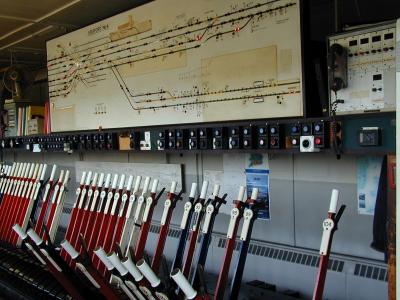
decisions on regulation. Stafford no.5 box has a 150 lever frame, albeit with
many spares, and is operated by one signalmen. It works to Norton Bridge
Junction controlling the four track main line north of the station including
a fast to slow junction
On the Thursday we were joined by Adrian Hassell and Tony Neath and we started at
about 9 a.m. dispatching the JCB driven by Dave Shackleford to crossing cottage
to make its way to site to assist in digging a shallow trench for the troughing
which will carry the permanent cable to replace the damaged section of cable and
the temporary repair. Two of the three cables required, a 12 core signalling cable and
a telecomms cable, had unfortunately
not been delivered the previous Friday and so the temporary repair will have to last
another week. With the assistance of the JCB between trains, protected with the
appropriate provisions of Rule 217, including a handsignalman (Dave Evans) in
the signalbox to remind the signalman of the presence of the JCB, the troughing
run was completed in what proved to be a very hot and exhausting day.
On the Friday we had arranged for the BN1 engine to be off shed at 8.0a.m. to
draw the coach out to site to allow us to pay out the 2 core power cable and then to
propel the coach to the end of the Hollybush siding to pay out two 2 core cables and
a 7 core cable to replace the temporary 10 core cable installed last year (installed
on the ground as the troughing run had not been completed). This was still working
perfectly despite the efforts of the Locomotive Department to cover it in hot ash
at every opportunity. The coach was then
shunted onto the BS1 engine and taken to Bewdley with the class 52 for the driving school.
The new 7 core and 2 core cables was terminated, tested and commissioned and the old
cable removed. The signalling cable for Oldbury viaduct did not arrive until late
in the afternoon and was laid out and terminated in early August just as the temporary
repair was showing signs of breaking down. The final cable - a telecomms cable - was
terminated on 12 August allowing the temporary repair to be removed. We hoped that
this would rectify a fault reported that week on the omnibus telephone circuit
between Bridgnorth and Hampton Loade but after a full day's work the fault was
still present and will have to wait for another day.
Major planned work
A brief recap of the major work planned by the Department will give you
a taste of things to come and illustrate that there is plenty of interesting
work for the Department in the months ahead.
Bewdley North Down Main Home Calling On Signal - the signal wire run is almost
complete and is tied off at the base of the signal, all parts for the fitting
of the calling on arm are available and a printed notice has been prepared. The electrical
wiring is mostly in place, as provision was made for this signal in the original
installation.
Kidderminster platform 1 starting signal - the Taunton bracket signal is being prepared
to replace the temporary signal installed over ten years ago and we are hoping to install this
and commission the platform 1 side. An electric lock will need to be fitted to no. 34 lever to implement
electrical detection before the three foot arm on the bracket can replace the
existing disc signal (34) currently on the ground.
Bewdley South Inner Home bracket - the wood on the existing bracket signal
will need to be renewed and to do this we will have to erect a temporary signal
while the existing bracket signal is removed and and the main central post renewed
with a new piece of timber. The new distant arm prepared for
Bewdley North Up Distant (which would not fit there) is to be used to replace the fixed
distant arm on this bracket beneath the From Kidderminster or Hartlebury to Back
Platform Inner Home Signal.
Kidderminster Advanced Starting signals - in order to obtain the correct clearance
for no.1 carriage siding, the present Down Loop Advanced Starting signals (58 and 61)
will be replaced by a bracket signal standing in the position of the existing
Down Main Advanced Starting Signal - the Westbury bracket signal is
to be used for this purpose.
Completion of the work required to bring the distant signals at Bewdley North
into use including a complete rewire of North Box. We are also considering
provision of a lower distant for South Box below Bewdley North Up Home - a
signal machine is to be overhauled and fitted, a distant lower banner is
to be fitted, using the banner recovered from platform 2 when the footbridge
was repainted, an outer distant repeater is to be provided in Bewdley South
and the distant signal and fittings are to be installed.
Facing point locks
This time I'll describe the purpose of facing point locks. These are required
to be fitted to all pointwork that is traversed in the facing direction by passenger
trains and to be interlocked with the signals so that movements over the points concerned
in the facing direction can only be signalled if the facing point lock lever is operated. The signal
will not clear unless the facing point lock has responded correctly to the lever
in the signalbox and this is effected by detection which proves that the correct
movement has occurred. We are often advised of S&T 'failures' when it has not been
possible to bolt points in place or where the signal will not clear when the
S&T equipment is, in fact, operating correctly. There are a number of potential
faults that will prevent the signal being cleared, most of which are problems
for the Permanent Way Department. Examples of these are track spreading wide to gauge,
ballast trapped in the switch rails, a signalman with only one Weetabix and broken
or buckled point rodding.
In such cases where the signal cannot be cleared, the Rules prescribe for the points to
be clipped in place and movements to be made under the control of a handsignalman
who takes responsibility under Rule 78(b) for the proper position of any facing
points to which the signal to be passed at Danger normally applies. A good example
of this recently was failure to bolt 42 points at Kidderminster due to the
switch blades standing high due to the diverging end of the points having
dropped. This had been reported several times as an intermittent S&T fault and when it
was reported as being unable to bolt the points we had to request attendance
of the Permanent Way Department as the only alternative was to book off the FPL
and clip the points normal. A rapid attendance by our P-Way colleagues made this
unnecessary.
We are always on the lookout for new recruits to the Department - some mechanical
or electrical knowledge is an advantage and the ability to work unsupervised
with a knowledge of one's limitations is essential. Existing volunteers will
know how to contact the Department but those considering volunteering
for the first time will need to make contact through the Volunteer Liaison
Officer, Peter Edkins.
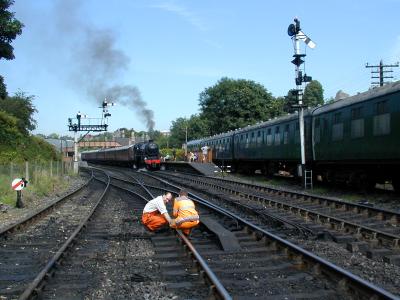
Examining number 14 points to see how much shimming will be required.
Stafford number 4 box showing the south end of the station.
Stafford number 5 box looking along the frame to the north.
Stafford number 4 box looking from the high end of the frame.
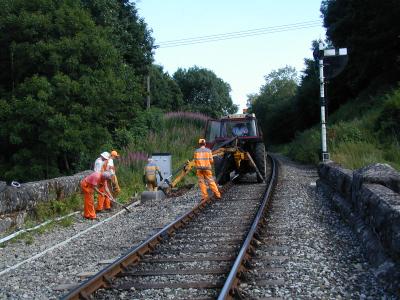
Nearly complete at 4.20 p.m. on the Thursday - just the finishing
touches and we can adjourn for a much needed refreshment at the Railwayman's Arms!