 SVR S&T Dept.

SIGNALLING NOTES - Chris. Hall
As I put pen to paper, we have been dismantling our equipment on the south end points (no. 12) at Bridgnorth (so that they can be moved about sixty feet closer to the station and off the road bridge) and are about to dismantle the yard crossover. The switch rails will then be replaced and we will, no doubt, get a call sometime in March to say all is ready for us to reinstate our bits.
In 2018 we had moved a compensator base (for 12 points and 11 FPL) about twenty feet closer to the signal box in response to complaints from signalmen over the previous thirty years that the points went out of adjustment in extreme weather. Measurement had confirmed the compensation error. It is perhaps unfortunate that we did not ignore the complaints for a little longer as the new intended position of 12 points has required us to put the compensator base back where it was in 2018.
As I have mentioned a compensator, I thought a brief explanation might be in order. The rodding run to 12 points at Bridgnorth has a total length of 278m and has to cope with temperatures from -5°C in a cold winter to about 45°C in direct sunlight. With a coefficient of expansion of 15x10-6 K-1 this would mean a change of length of 208mm which is twice the switch movement from normal to reverse. The compensator sits half way along the rodding run and turns a push into a pull.
We were most pleased to receive special thanks for a swift response on Sunday 18th December and the following day. The south end points at Arley had been damaged on the Saturday afternoon and the news had gradually trickled through to us via the South Devon Railway and Bridgnorth bar. On the Sunday we removed the point detection rods, the drive rod and the mangled FPL stretcher, leaving just the bare switches, ready for the P-Way to do some repair work. Signals reading over the point were disconnected and a handsignalman deployed. After a repair by the P-Way, the mid week S&T staff worked into the evening recommissioning, adjusting and testing so that normal working could resume on the Tuesday. The only effect on the train service was the cancellation of two round trips by the third service set on the Sunday.
Now that the new footbridge has been installed at Kidderminster, we have received complaints that it affects the sighting of the temporary platform 1 starting signal. This signal has been �temporary‘ now for forty years but its replacement, the bracket signal from Radyr Junction, still needs work to complete its refurbishment and, ideally, would require the fouling point from platform 2 to be adjusted and the island platform extended.
The first step is to fit a sighting board. We have a rather heavy and soiled sighting board from another signal but its framework is in good condition. We ordered a new sighting board but the challenge is to fit the framework around the route indicator. We measured it up on 29th January using a mobile working platform (MEWP) and were able to accommodate the fixing brackets using the crows‘ nest bracket for one. Meanwhile the new board was drilled to suit and was fitted later that day. So far as I can tell, if further complaints ensued, Western practice was to fit a centre balance arm (I haven‘t seen one with a route indicator) as a clear message that there was no point in making any further complaints.
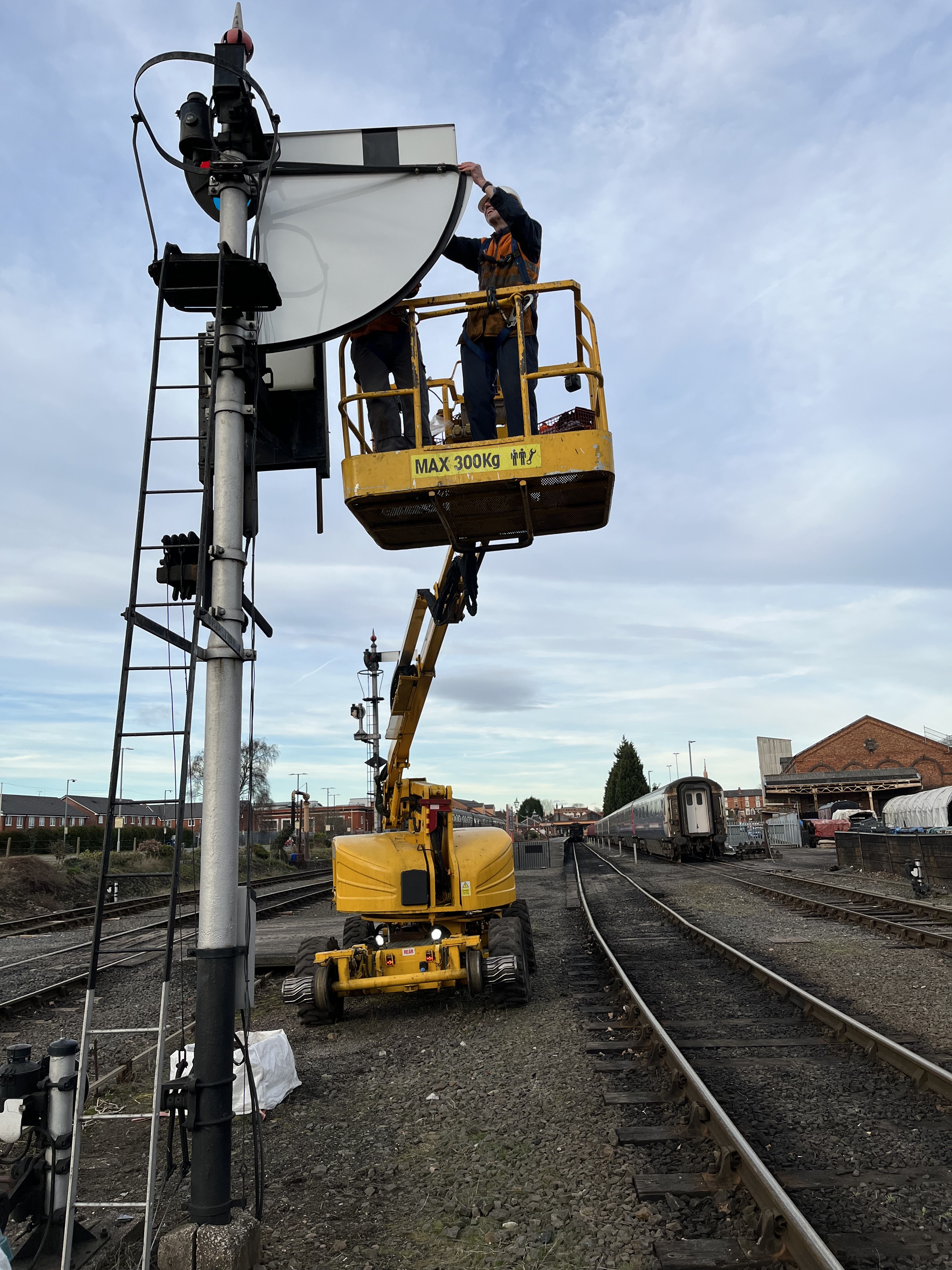 Work in progress on Sunday 29th January - a swift response to complaints about signal sighting against the background of the new �pre-rusted‘ footbridge.
The timetable for March to June has just been announced to the public (and the working timetable will soon be available for the staff) and will be a restricted service of two trains from the south end to reflect low season demand. There was at one time a plan to build a signal box and crossing loop at Erdington to split the longest block section on the line, that from Bridgnorth to Hampton Loade. Any such plans can therefore safely be put on hold. Photographs of the unused Erdington North Junction cross over have recently surfaced on Facebook.
Regular routine maintenance and testing continues according to a maintenance schedule and is the main activity of the mid week staff. They have also made a concerted effort to align the signal lamps more closely to the Driver‘s eye level and position on approach - with a bull‘s eye lens this can greatly improve night-time visibility and is much easier to do with a MEWP.
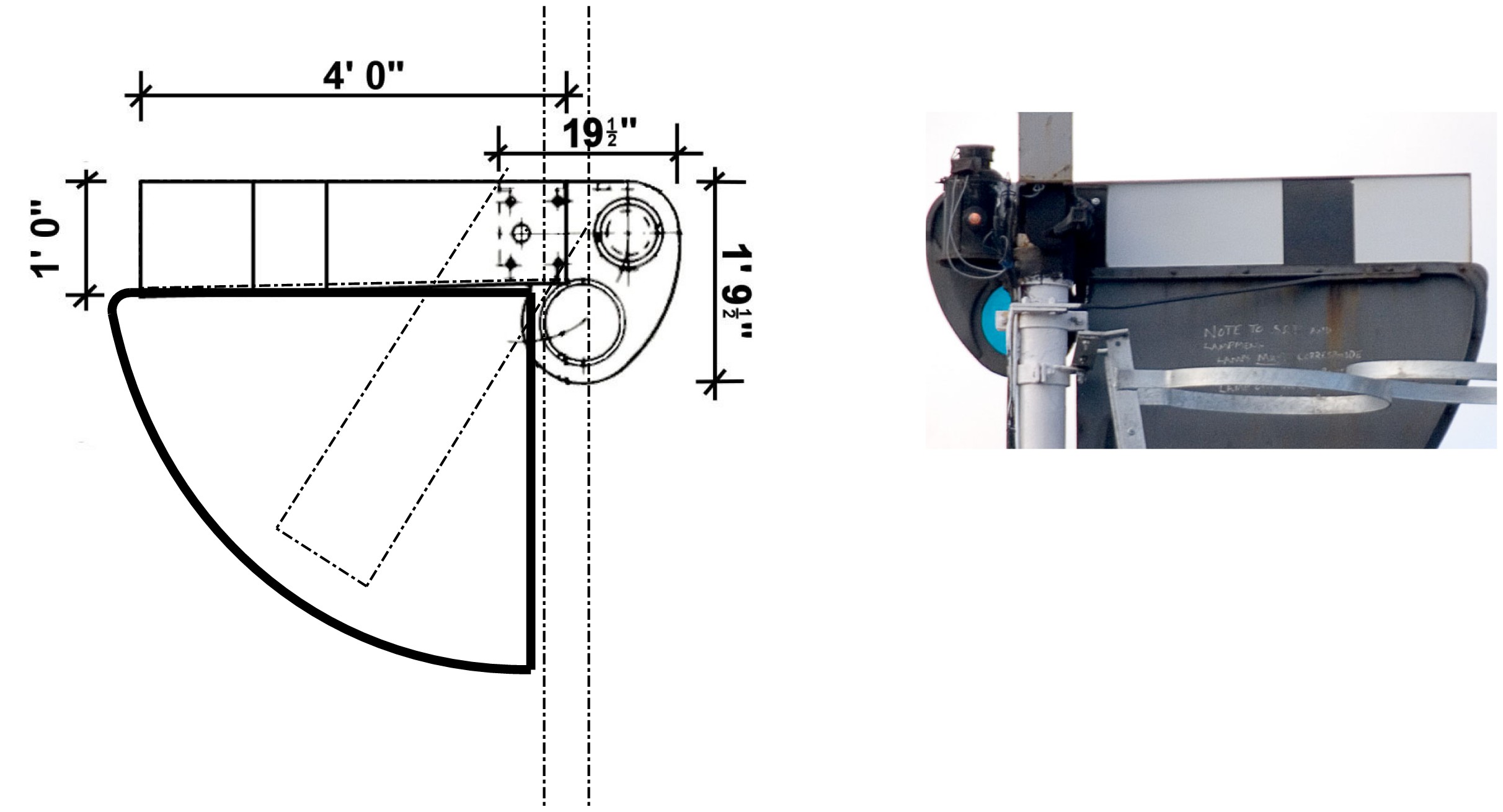 Drawing of a sighting board for platform 1 starting signal. Drawing: C.K.Hall
On the electrical side, work on fitting new power supplies and relays to the track circuits between Bewdley and Kidderminster continues. Changeover to the new equipment in February will require a large commissioning team with someone at each location cupboard and the requisite documentation to record this has been drawn up. We shall soon have another combined effort between the electrical and mechanical teams to replace a failed section of 110V power cable from the Up Starting Signal at Bewdley South to the Down Distant. A modern Alstom location cupboard has been donated to us and has been stripped down providing a usefl (and free) source of spares. It is surpriding how much work is required in refurbishment and renewals simply to stand still and maintain safety standards. Reliability of the track circuit indications on those signal box diagrams that used Post Office filament bulbs (i.e. Kidderminster Station, Bewdley North and Bridgnorth) has been improved by fitting LED replacements - the necessary bulb holders were produced by Andy McBeth using 3-D printing.
A reminder that this article, as well as other information on Signal Engineering, can be viewed in full colour here on the unofficial Signal Engineering web site.