 SVR S&T Dept.

SIGNALLING NOTES - Chris. Hall
During November, December and January our activities were able to follow a more sedate pace (apart from a bit of a flurry during November and time in January spent in briefing and preparing for the new Rule Book) as the finishing touches were added to the new bracket signal at Kidderminster.
The final bit to be fitted was the front handrail, after which the topping out ceremony could take place. 42B points had been moved by the P-Way (planned to be 1st November but actually 20th November before we could get access) and the topping out ceremony was held on 21st November with some invited guests. The MEWP was used to fit the finials - the last items - and the signal was then fully finished and commissioned.
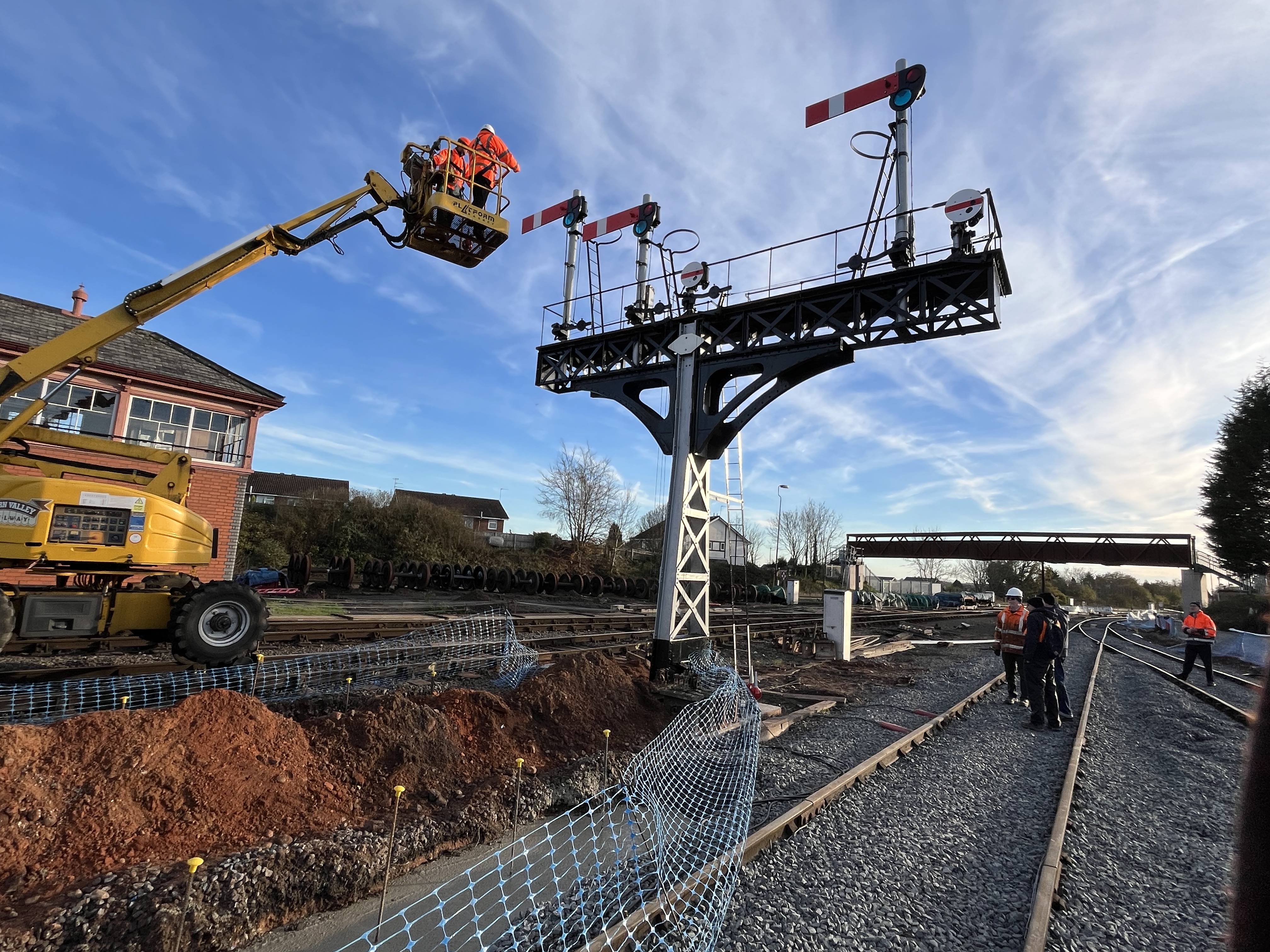 The MEWP is reaching out to fit the first finial on 21st Nov. The foundations for the platform 2 retaining wall have been cast but the site still looks like a building site. [Phtoo: C. K. Hall]
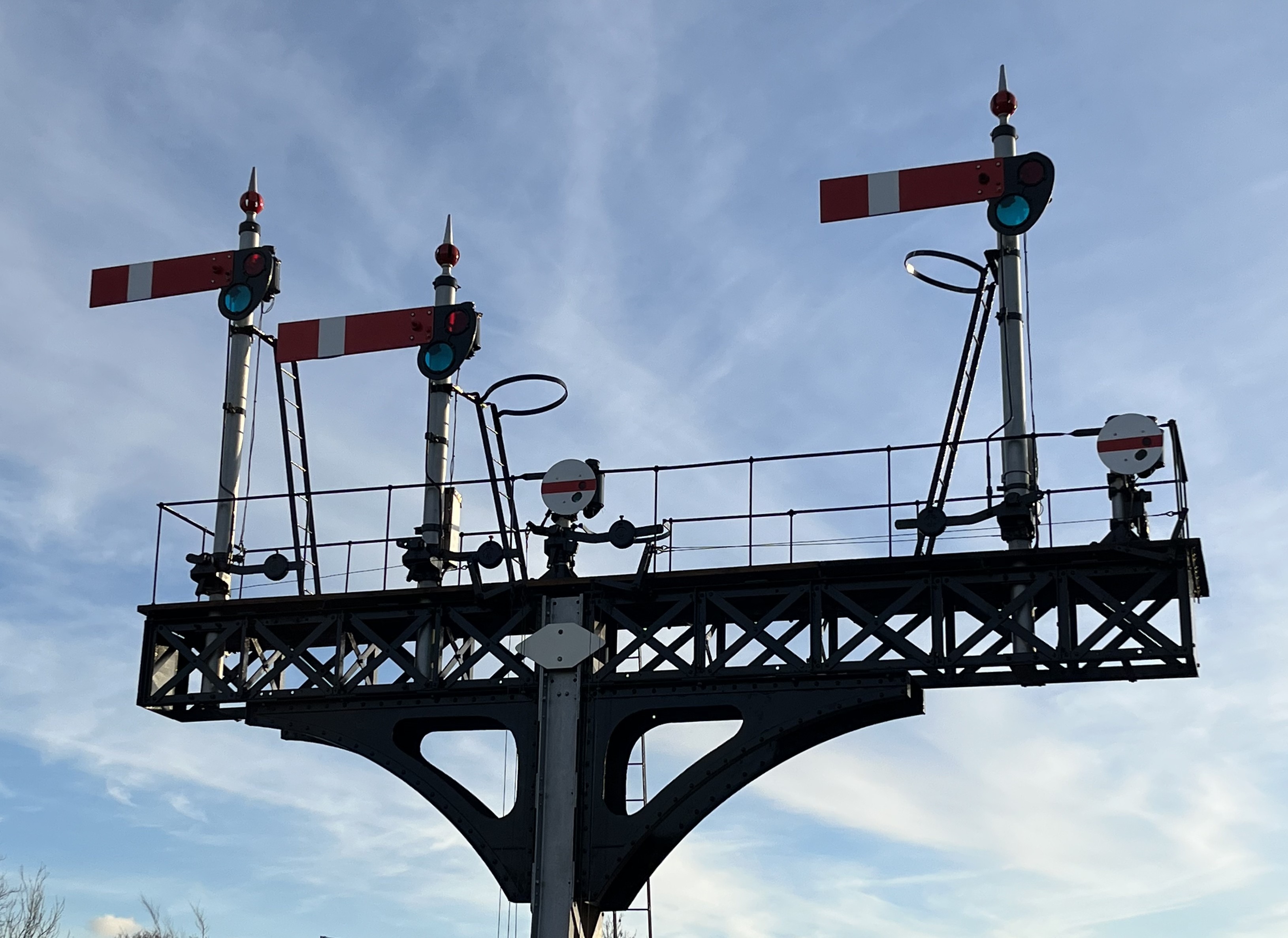 with good weather on 21st and by 3p.m. the new signal was in its finished state. [Photo: C. K. Hall]
We had many offers of additional help with the platform extension works (as far as they affected our signalling equipment, that is) but the Department was placed in the strange position of turning people away as we remained �in limbo‘ awaiting completion of work by the P-Way (we needed �wheels free‘ access with the new track tamped for the next bit) but we waved the green flag for work to start on Wed 26th November: a tester was booked that day to test the track circuits and the enormous task of laying and connecting up the rodding could start.
The initial plan was to use one team to install the detector box on 41/42B and for the other team to assist with testing the detection and the track circuits so that by Friday the points could be secured normal and the DMU be able to use platform 2 under the control of fixed signals for the first weekend of Santa running. The possession from Monday 1st to Fri 5th Dec would see the rodding run completed and 2EL brought back into use.
We had a large enough turn out (no pun intended) on the Wednesday to split into three teams. The new rodding run would have to take a different route as 42B points had moved significantly and the existing run to 42A was where the platform extension would be built. The existing run had two compensators but a cunning plan drawn up by Paul Marshall in December 2024 managed to avoid any compensators by careful positioning of cranks.
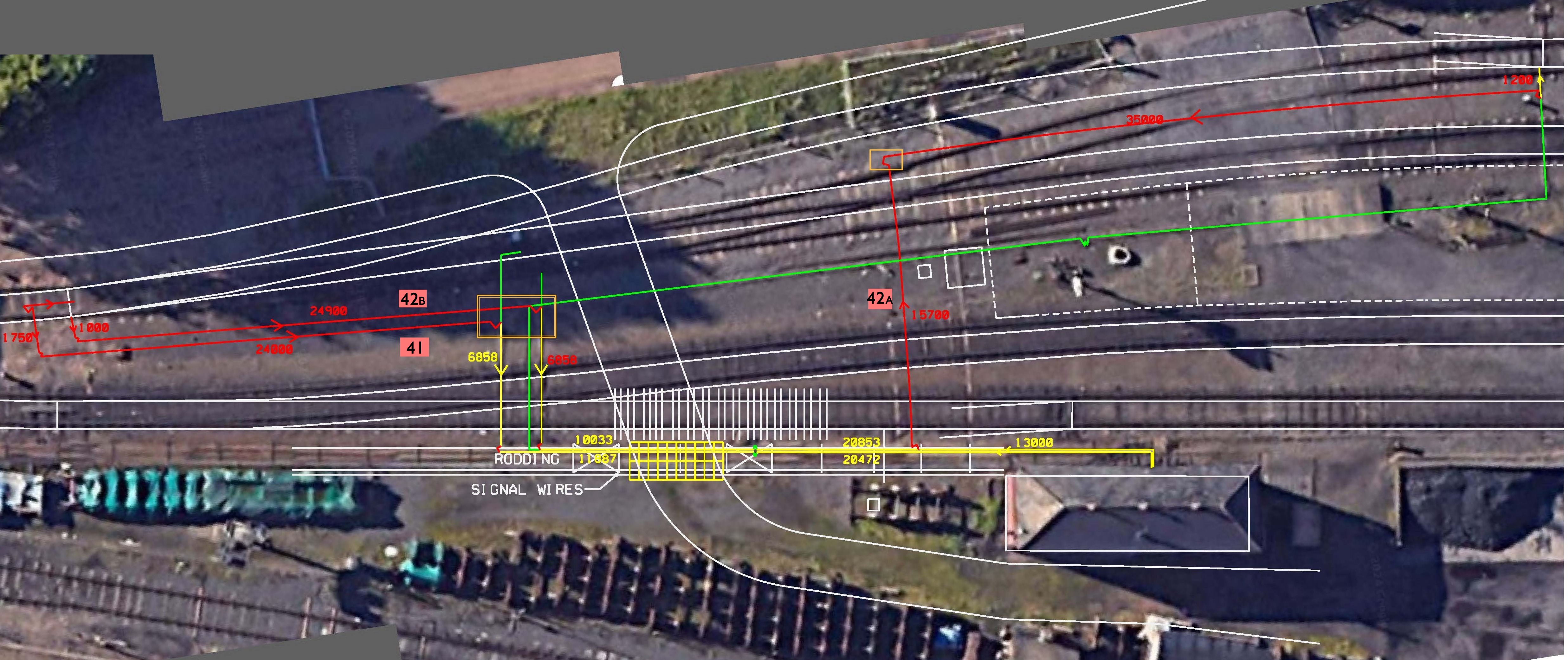 This plan shows the existing rodding run to be removed (green) and the new run (red), two large holes to be dug (orange) as well as the new platform and planned route of the new trackwork. [Diagram: P. Marshall]
The first step was to dust off the plans and dig a large hole (orange outline) for the crank for 41, already assembled onto a steel plate and two 5-hole concrete blocks. The crank for 42B, similarly pre-assembled, would also go into this hole. We were fortunate in having Ollie all day to drive the excavator as there were more holes to dig! Another seven rodding stools for 41/42B and a similar number for 42A, all of these having to be in a straight line and at the right depth. Fifteen lengths of point rodding, each 18 feet long, were laid out for the 41/42B run.
Meanwhile the other half of the team were starting to lay the rodding run to 42A. By the end of the second day, the rodding to 41/42B had been cut to length, approximately adjusted and the points and FPL worked from the box (something we had not expected to have finished that week). The detection on 42B was commissioned, the new disc signal no. 40 put in its place and the track circuits connected and tested.
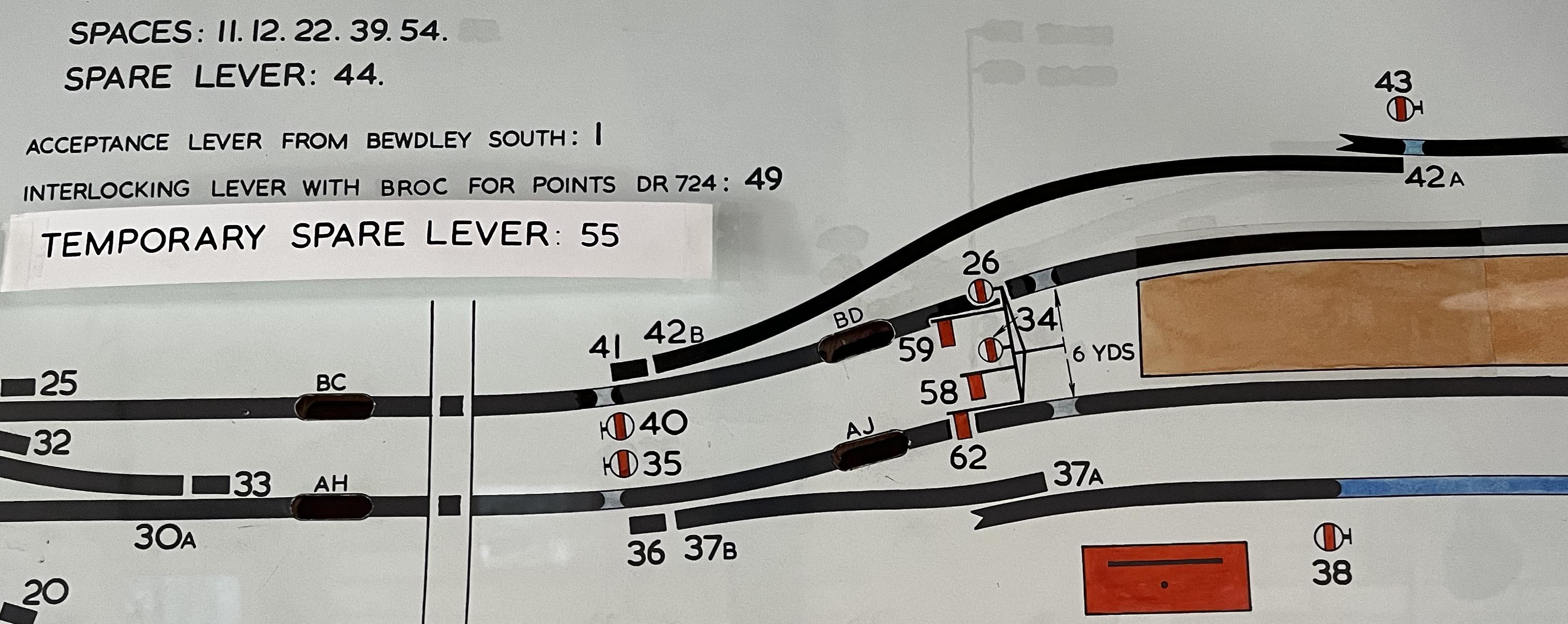 The box diagram has now been revealed in its final form with a paper overlay to say that 55 lever (which will release Foley Park ground frame during traffic hours once work is complete) is, at present, a temporary spare lever. [Photo: C. K. Hall]
Disc signal 40 has been fitted with an opaque cover as a temporary expedient due to possible signal sighting issues for diesel drivers. We will try to ensure that this temporary arrangement lasts no longer than did the temporary platform 1 starting signal (38 years). The wire run to 43 and 46 signal could not be reinstated until the platform foundations had been cast. These will have to be on temporary stakes, and the adjacent cables laid loosely alongside, as the eventual plan is to secure all to the new platform wall once it is built early next year.
The new wooden post for the Arley Up Distant was our next job. Various castings have to be attached, the largest of which (the spindle casting and the balance lever casting) are located in slots and blind holes so that they are firmly held in place. Measuring several times and cutting once is the menu for success - the down rod is a fixed length with limited adjustment. Holes for the coach screws and through bolts have to be drilled true to the centre line rather than the tapered face. The castings were then removed again so that the post could be painted with primer, undercoat and gloss.
The MEWP was used at Bridgnorth on 19th January to fit a new crank to the platform 2 starting signal bracket to rectify a fault reported in September. The plate holding the crank driving 27 spring trap points was cracked and a new plate was delivered and its dimensions checked. This will be fitted at a convenient time this Winter. Other work at Bridgnorth included stripping rotten planks off the Down Inner Homes bracket ready for renewal.
A reminder that this article, as well as other information on Signal Engineering, can be viewed in full colour here on the unofficial Signal Engineering web site.