 S & T Notes - issue 134
 S & T Notes - issue 134

As a prelude to our annual working week we have wined and dined on the train. Those of the S&T resisting the lure of the bar pose for a photograph at Bridgnorth.
SIGNALLING NOTES - Chris. Hall
The Department has been busy in the last three months (June, July and August 2000) but we now have several projects 'on the go'. It is not unusual for some of our projects
to take some time to complete so I have looked back through the archives to see when we started work on the Bewdley Distants - a couple of quotes from the Volunteer Newsletter
might not go amiss:
Routine maintenance is not far away from being up to date in most areas but continues to soak up a lot of our resources. However once a year the Department has a 'working week'
(this year it was two working weeks if you include Easter week but that did stretch our resources a bit). Tradition has it that the Department gathers for a Sunday meal on the
Venturer before the working week so we gathered at the King & Castle at the appointed hour for a convivial drink joining the Venturer shortly before departure
at 1 p.m. Wined and dined, a rare group photograph was taken (above) after which members of the Department dispersed to their favourite drinking establishments, mainly
the Bird-in-Hand at Stourport on Severn and the Railwayman's Arms at Bridgnorth.
As we now seem to be able to obtain signalling turns whenever we want them, the emphasis has changed and only one day of the week is devoted to signal box turns, planned
to be the Monday. The major work was renewal of location 2 at Bridgnorth but the opportunity was taken to carry out 'heavy maintenance' on other parts of the installation
at Bridgnorth.
Later that afternoon (from left to right) Dave Stowell, Denvir Drury and John Taylor may be seen in their native habitat.
S & T Week
On the Monday a group of four (Denvir Drury, Ray Atkins, Steve Curtis and Chris Hall) started excavations to plant the new location cupboard. The original plan for the Monday was
for the signalbox turns to be covered by S&T personnel but the operational needs of the railway dictated that box turns at Bewdley North would be on the Tuesday (Chris Hall)
and Wednesday (John Smith), those at Highley and Hampton Loade would be on the Wednesday (Ray Atkins and Steve Bach) leaving only Kidderminster and Bridgnorth (Adrian Hassell) on the Monday as planned. After a long day spent digging the ballast and burying two large lumps of concrete a carefully calculated distance apart, the delights
of a Wetherspoons pub in Kidderminster rounded off the evening nicely.
On the Tuesday the working party was joined by John Phillips and Adrian Hassell - the location cupboard was 'planted' and the remainder of the troughing run was
completed. On the Wednesday the working party was joined by Dave Wittamore and John Taylor allowing a splinter group to visit Bewdley. Whilst cutting some troughing to fit
neatly, the CS&TE managed to sever part of a 10-core telecomms cable with the angle grinder. The cable concerned was scheduled to be replaced once the troughing run
between the boiler shop crossing and location 1, the Boiler Shop Ground Frame, had been installed. At present it carries signalling circuits as well as telecomms circuits
so that access to the Ground Frame was not available until the next day when the cable was repaired and tested. The accumulation of ash, water and unmentionables around
no. 25 disc at Bridgnorth was taken away in several wheelbarrow loads and the 'stab' detection cleaned and oiled after complaints about operation of the dummy. The Bewdley
splinter group replaced the lamp in the Bewdley South Down Home Signal (not a trivial job as an extension ladder had to be carried over a mile to do this). A few broken or
damaged track circuit bonds in the area were also repaired. Initial investigation into an intermittent fault on the Bewdley South Down Main Distant showed that there was
insufficient voltage to pick the 0DR relay when the signal lamps were illuminated, which will need further attention. The local power supplies fed from a 110V source were
pefectly sound.
Opportunity was taken in the evening (after a hurried meal of fish and chips) to listen to a talk by the Company's Accountant, Andrew Harding, to the Bridgnorth group of the
SVRA in the buffet. It is a rare occasion in recent times for the Department to meet in numbers for an evening drink at the Railwayman's Arms. By the Thursday cable
termination was proceeding in earnest and a splinter group was sent to Bewdley to remove the operating coil from Bewdley North Up Home Banner Repeater for repair.
It was noted that the lamp had been disconnected. The coil is currently being rewound and by the time these notes are published, both lamp and banner should be
operating normally.
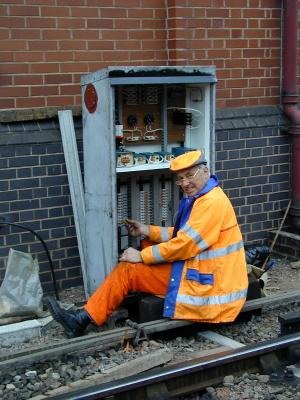
On the Friday cable termination proceeded (below), by now the province of our expert terminator, there being room for only one person to work. The rest of us turned our
attention to routine testing and heavy maintenance. Routine F.P.L. and detection testing was carried out and tight detection on 18/29A (open switch) attended to by
hacksaw. A curious twist on 14B normal closed switch was observed - somehow this crossover appeared to have been run through despite having an electric lock controlled
by the track circuit and will need attention from the Pee-Weigh as the FPL narrowly fails the routine test. Track circuits 11T and 14T were carefully examined and several
broken or flattened bonds were replaced to obviate any potential wrong side failures - in one case requiring the services of the Pee-Weigh to remove and replace a check rail.
These track circuits were then thoroughly tested over their full length. Reports of 12 points being 'heavy' caused us to lubricate the slide chairs and to remove sundry loose
ballast from the rodding run. It was noted that, during work to fit a replacement signal box door, the cable from the platform 1 RA plunger mounted on the signal box wall
had been severed and this was repaired. Broken bonds on 5T (the track circuit through platform 2) were replaced on the Sunday which required the use of a rail drill.
Other projects
Manufacture and installation of a new 5-doll bracket signal to control departures from platforms 1 and 2 at Kidderminster proceeds at a slow pace, awaiting developments on
the barrow crossing and platform extension. Work in association with a connection from no. 2 Engine Line to the turntable awaits developments on the footbridge
extension. Installation of fully functioning AWS has been put on one of our many 'back burners' until some more testing of new trains comes along. Meanwhile a
new sighting board and new signal arm have been fitted to the Bewdey South Down Home Signal.
Defect rectification
The circuit controller on no. 47 lever at Kidderminster was stripped down completely, cleaned and adjusted following some reports of difficulty and should now be
satisfactory. Notices have been placed on lever frames reminding those concerned of the need for economy when applying oil. Meanwhile we will probably have to
remove, strip down and clean most of the electric locks which have been soaked in oil.
The fixed rod which holds the detection slide the correct distance from the rails at the south end of the yard at Highley broke and we found the signal
disconnected. The rod was rewelded by Station staff and we were able to reconnect the signal - a permanent repair is in hand.
On a lighter note the route locking on no. 14 points at Kidderminster was tested recently by a Signalman and found to be in normal working order provoking
the comment "I said that move would not work." The treatise on approach locking and route locking in issue 132 has obviously made an impact and it is
encouraging to see that a healthy debate has started through the letters page on such an abstruse subject. I shall leave it to those more experienced than I to comment.
One of the many tasks of the S&T Department is to ensure that any imbalance in the movement of tokens is corrected by moving a requisite number of tokens in the
opposite direction. The security of the single line depends on only one token being removed at a time and no member of the Operating Department can have access to
more than one token. The Engineering Department must, however, be able to deal with faults and failures and is permitted to remove more than one token under carefully
controlled conditions. The Block Regulations provide for transference of tokens so that the duty Signalman notes how many tokens have been removed and this is recorded
in the token transfer register as wellas the Train Register. The tokens are then counted back in at the other end of the Section. The timetable is arranged so that the
normal train service ensures a balanced movement of tokens but additional movements such as Pee-Weigh trains can upset the plan, for example if the movement in one
direction is on a short section token and the other on a long section one. Only a very few members of the S&T Department are authorised to move tokens so it
is not something that can be done at the drop of a hat. We therefore have to rely on the vigilance of signalmen to ensure that crossing boxes are switched out
where the opportunity arises if most of the tokens have moved to one end of the section. No excuses are accepted on a table C service if there aren't enough tokens
to run the evening service - we're usually in a pub by then muttering darkly into our beer.
Following a possible wrong side failure elsewhere in the country, the Railway Inspectorate requested us to ensure that at times of failure of the road traffic
signals at our only open crossing, there was no risk of Drivers receiving a white light (proving that the road signals were operating correctly) when neither
of the road lamps on one side of the crossing were lit. During August testing was undertaken and a report submitted to HMRI and their reaction is awaited.
Block controls
'Line Clear' may only be pegged on the 'pegging' instrument at box 'B' if the home signal (the stop signal at box 'B' for trains approaching from 'A') is at Danger, the
distant signal at Caution and the home signal berth track circuit clear. Only when the block instrument at box 'A' indicates 'Line Clear' can the signalman there pull
off his section signal for the train to proceed to 'B'.
When the train leaves 'A', the signalman at 'B' is notified and will normally peg the block to 'Train on Line'. However occupation of the home signal berth track circuit
at 'B' would force a 'Train on Line' indication - if 'forced' in this way, the indication could only be released (once the track is clear) by first pegging the block to
'Train on Line' and then unpegging it. Once the train has arrived at 'B' complete with tail lamp the block is unpegged to 'Line Blocked'.
A final reminder that this article and the photographs associated with it, as well as other S&T information, can be viewed in full colour on the
unofficial S&T web site at http://www.home-in-bristol.fsnet.co.uk/.
Our termination expert, Denvir, poses for a photograph.
"On the horizon is the scheme to install working distant signals at Bewdley North and South. This involves more work than you think, so it won't be a quick
job" (September 1988)
"... provision of working Distant Signals at Bewdley is progressing well ... the necessary work on the lever frame at Bewdley North has also commenced ...
if platform 2 at Kidderminster goes ahead it will take priority for use of our resources" (May 1989)
"Then there are those Distant Signals for Bewdley North which still don't work. There's a lot of work to do there,
which will probably start in mid-1991" (December 1990)
Well we completed mechanical work on the frame in North box earlier this year, as reported in the last issue, which I described as 'phase 1'. This has now settled down
and steady (but slow) progress is being made on the work outside the box. This work includes a new cable run between the Up Home and the Down Starter to provide
sufficient power to operate the Up Distant signal machine, a new South box Up Outer Distant signal and banner repeater beow the Up Home, a new disc signal and wire run
at the Up Inner Homes (to read to the Rock Siding), a new calling-on arm below the Down Main Home, which will require a new wire run and the Down Main Home signal to be
raised to make room. Before these can be brought into use, rewiring of North box will have to be completed - the design work for this is just getting off the ground. I'm not
sure which of these will get our attention first so I won't try to say which will be 'phase 2' until a bit later on but the three elements are 'outside work', 'new cable' and 'rewire'.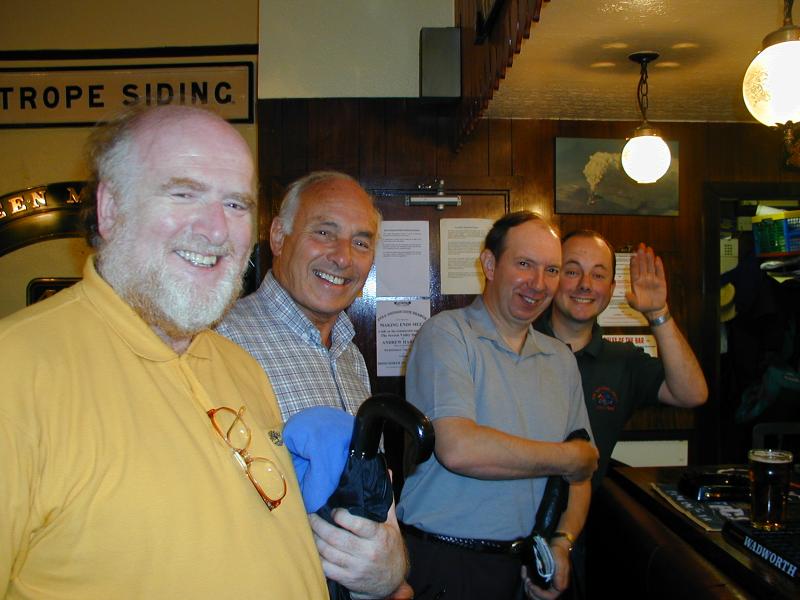
The first job was to dig a hole in the ballast to plant the concrete feet on which the location cupboard would be mounted. New track circuit cables which had previously been
laid out at location 3 (at the end of the siding behind platform 2) could then be terminated. The existing cable from location 3 to location 2 was to be disconnected and
reterminated in location 3 to release space in the cable duct entry to that location. The troughing run would then be completed allowing new cabling to be run between
location 2 and location 3. In addition, a new terminal block was to be fitted in location 3 to allow termination of a 10 core plus 2 core cable in place of the existing
10 core cable. Orange pipe and new track circuit cables would be laid adjacent to the new site, as well as cables to 28/30G (7 core) and 25G (2 core). All new cables would
be terminated in the new location cupboard - where they replaced existing circuits then the existing circuits would be 'top nutted' at the remote end and the new cable
connected with the links removed. The new track ends would be connected to the rails with the existing track ends temporarily soldered to the new copper D's (see below) and
the new cable links removed. This would leave the 10 core telecomms cable from location 1 to be rerouted from the old to the new location 2 (or be replaced if the troughing
run had been installed) as part of commissioning at a later date.
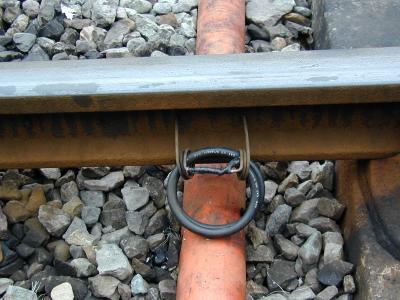
A new track circuit cable connection.
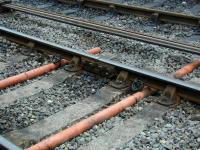
New track ends, protected by orange pipe.
Cable drums of 1 core, 2 core and 10 core signalling cable had been transported to the site some time ago as well as a coiled length of 7 core cable. Most of the troughing run
had been dug in at this time as well.
The commissioning and change over date for the new location cupboard (which will require a day of handsignalling) has yet to be decided.
The depot protection scheme for the new Carriage Shed at Kidderminster is still in its formative stage as the 'Pee-Weigh' Department has not yet run out of track and pointwork -
it is still installing more sidings so we will have to wait and see where all the pointwork finishes up before we can design the ground frame and any rodding runs, compensation,
signal positions etc.. The S&T element of this project has now become significantly more difficult and will take us longer and cost much more to implement to ensure safe
operation of the yard as the track layout has become more complex. The various connections are likely to remain as hand points for some time.
Intermittent problems with pegging 'Line Clear' on the Down Main block instrument at North box became a solid fault which was traced to contacts on the DMIR (Down Main
Interlinking Relay) under the box. The contacts were readjusted and extensive testing showed the fault to have cleared.
A short description of the controls provided on absolute block instruments is the chosen subject this time. For each pair of running lines three wires (and an earth
return) connect the instruments in each box - a bell wire and an 'up' and a 'down' block wire. The operation of the block controls is best described in the traditional
way with a train proceeding from box 'A' to box 'B'. The signalman at box 'B' (the box in advance) controls the state of the block and can give permission for a train
to approach by pegging 'Line Clear' on his instrument (the polarity of the block wire determines whether 'Line Clear' or 'Train on Line' is shown on the instruments and
the state of the block is indicated in both boxes). With the wire open circuit, 'Line Blocked' is indicated.